Data Centers: The New Neighbor No One Expected
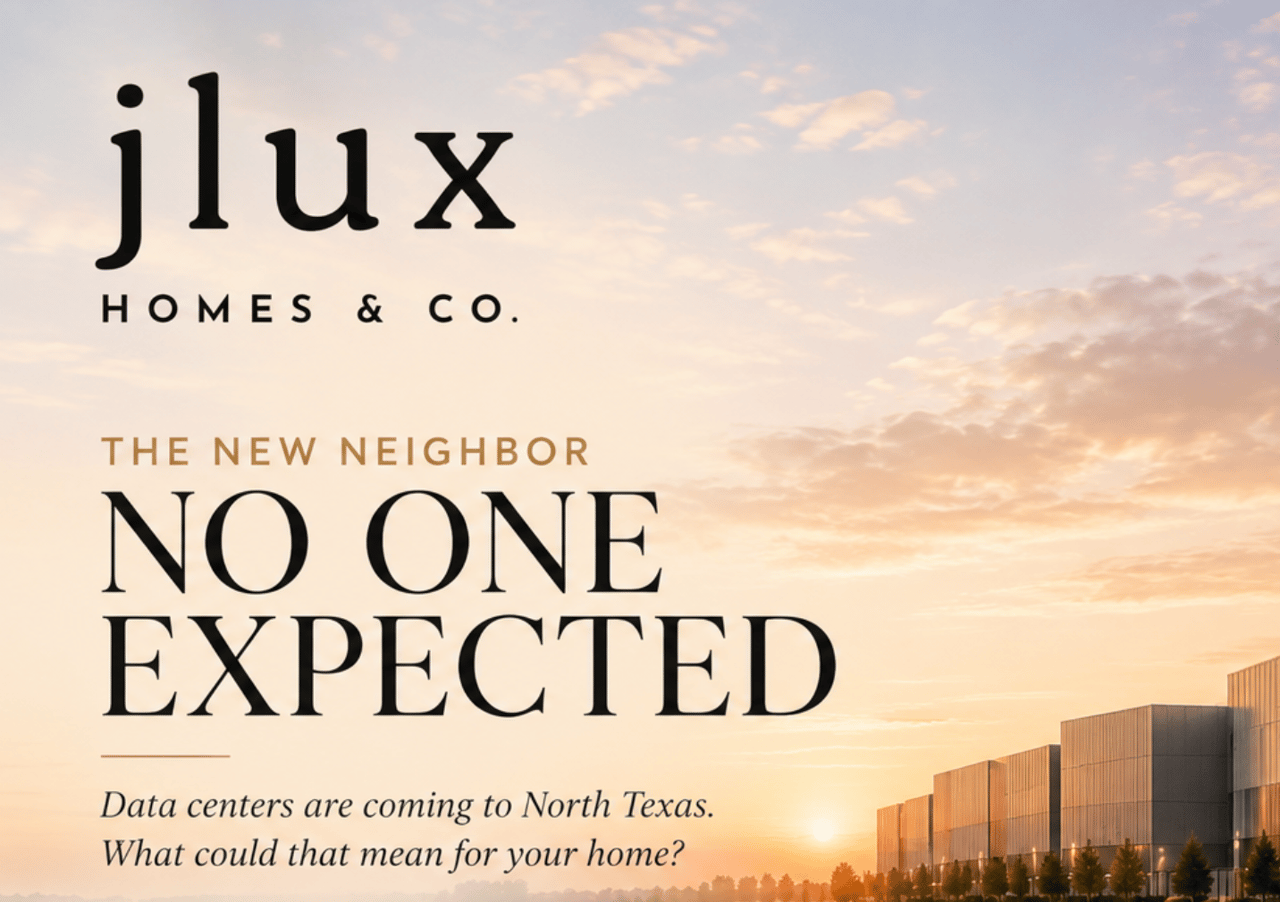
As data centers move closer to North Texas neighborhoods, homeowners are beginning to ask what their arrival could mean for the communities—and home values—around them.
If you live in North Texas, chances are you've heard a lot more about data centers lately. Until recently, most homeowners probably gave them very little thought. They were something we associated with technology companies and industrial areas—the largely invisible infrastructure behind our increasingly digital lives.
That is changing quickly. Hundreds of new facilities are being proposed across Texas, and North Texas is expected to receive a significant share of them. More importantly for homeowners, some of these projects aren't being tucked away in remote industrial corridors. They're being proposed much closer to established communities.
We've seen that conversation play out locally with the proposed Circle T data center campus in Westlake, near the Keller city limits. Nearby residents have raised concerns about noise, visibility, traffic, power infrastructure and water usage, but beneath many of those concerns is another very understandable question: What could a development of this scale eventually mean for the value and marketability of the homes around it?
It's a reasonable question, although the answer isn't nearly as simple as some headlines make it sound.
One of the more interesting studies released this year looked at Loudoun County, Virginia, one of the country's most established data-center markets. Researchers found that homes within approximately half a mile of an already-announced data center sold for roughly 2.8% less than otherwise similar homes located slightly farther away. That doesn't mean a data center automatically causes every nearby home to lose 2.8% of its value, and broader research hasn't shown that simply having a data center somewhere in a community universally lowers home prices. What the emerging research does suggest is that proximity may matter.
From a real estate perspective, that isn't particularly surprising.
Data centers may be a relatively new consideration for homeowners, but external influences around residential property certainly aren't. Over the years, we've watched buyers respond to high-voltage power lines, electrical substations, utility easements, railroad tracks, wastewater facilities, water towers, major roadways and homes that back directly to large commercial developments. None of these automatically makes a home undesirable, and their impact can vary tremendously from one property—and one buyer—to another.
What they can do, however, is change the way a buyer experiences a home.
Sometimes it's visual. Someone walks into an otherwise beautiful backyard and immediately notices transmission lines beyond the fence. Sometimes it's persistent road or rail noise. Sometimes it's an odor from nearby infrastructure, additional traffic from commercial development or simply the knowledge that another comparable home is available without the same external influence.
That distinction matters because buyers don't experience real estate on a spreadsheet. They may begin their search by comparing square footage, school districts, lot sizes, updates and recent sales, but eventually they stand in the house. They walk into the backyard. They listen. They look over the fence. They drive the surrounding streets and imagine what it would actually feel like to live there.
Not every buyer will be concerned by the same things, nor should we assume they will be. But when an external influence causes some buyers to prefer a comparable property elsewhere, the potential buyer pool becomes smaller. Over time, that can affect marketability, negotiating leverage and resale value.
That is why I think the data-center conversation deserves more nuance than simply asking whether these developments are good or bad for property values.
Their potential impact extends beyond the building itself. Data centers operate continuously and can require significant amounts of electricity, while some cooling systems also use substantial amounts of water. Cooling equipment, generators and electrical infrastructure can create ongoing sound, and additional transmission lines, substations, road improvements or utility easements may accompany a development. Texas policymakers are already discussing issues such as residential setbacks, noise-reduction measures, water-efficient cooling systems and how infrastructure costs associated with these facilities should be handled.
For homeowners, that makes the details of an individual project particularly important. A data center several miles away and surrounded by industrial development isn't necessarily comparable to one bordering an established residential neighborhood. A water tower somewhere in a community isn't the same as having one immediately behind your property. A shopping center two streets away isn't the same as looking into its loading docks from your backyard. Power infrastructure in the general area isn't the same as having a transmission easement running across your lot.
The same thinking should apply to data centers.
If one is proposed near your community, the first question probably shouldn't be whether your home value is going to rise or fall. It's worth understanding exactly where the project will sit in relation to nearby homes, what residents will be able to see and hear, how the site will be screened and lit, what type of cooling system will be used, and what additional power, road or utility infrastructure could accompany it. City boundaries matter less to a homeowner than actual proximity; a project technically located in another municipality can still sit just beyond a neighborhood fence.
North Texas isn't finished growing, and that's a good thing in many respects. Growth brings investment, jobs, new communities, businesses and infrastructure. It is one of the reasons this region continues to attract people and companies from across the country. But growth also changes the communities that are already here, and understanding those changes is part of understanding real estate.
When we're evaluating a home for a client, we don't look only at county statistics or the most recent comparable sales. We look at the micro-market surrounding that property: the neighborhood, school district, competing inventory, new construction, future development and the external influences a future buyer will encounter when they arrive.
We're still learning what the long-term relationship between data centers and residential property values will ultimately look like, and it would be premature to say that every nearby property will either benefit or suffer. What we do know from years of watching buyers make decisions is that proximity, perception and the experience of living in a particular location matter.
Data centers may simply be the newest—and considerably larger—version of a conversation real estate professionals and homeowners have been having for decades. Because when someone buys a home, they're never buying only what exists inside the property lines. They're buying into everything that comes with living there.
Stay up to date on the latest real estate trends.

October 2, 2026
The headlines may feel a little scary—but there are some surprisingly sweet opportunities hiding underneath.
September 23, 2026
Timeless style. Practical design. And a little bit of Texas charm.
August 17, 2026
Data centers are rapidly expanding across North Texas. But what happens when one is proposed near an established neighborhood—and what could it mean for the people who… Read more
July 2, 2026
Why Texas Homeowners Should Pay Attention to This National Trend
June 19, 2026

May 6, 2026
Insight, connection, and fresh perspective from the SIDEXSIDE Conference

March 22, 2026
A question many of you have been asking lately.

February 20, 2026
This Buy Before You Sell Option Changes Everything
January 24, 2026
Whether you’re buying or selling, we’d love to help you!